What is Disk Space?
Disk space is the amount of storage capacity a computer, server, or hosting plan provides for holding files and data, measured in bytes — most commonly gigabytes (GB). In web hosting, disk space determines how many website files, databases, email messages, and backups your account can store.
More About Disk Space
The “disk” in disk space comes from the spinning magnetic platters inside hard disk drives, a technology IBM introduced in the 1950s. The name stuck even though most hosting now runs on solid-state drives (SSDs), which have no disks at all. Whatever the hardware, the unit is the same, scaling from megabytes (MB) to gigabytes (GB) to terabytes (TB).
What uses disk space on a website?
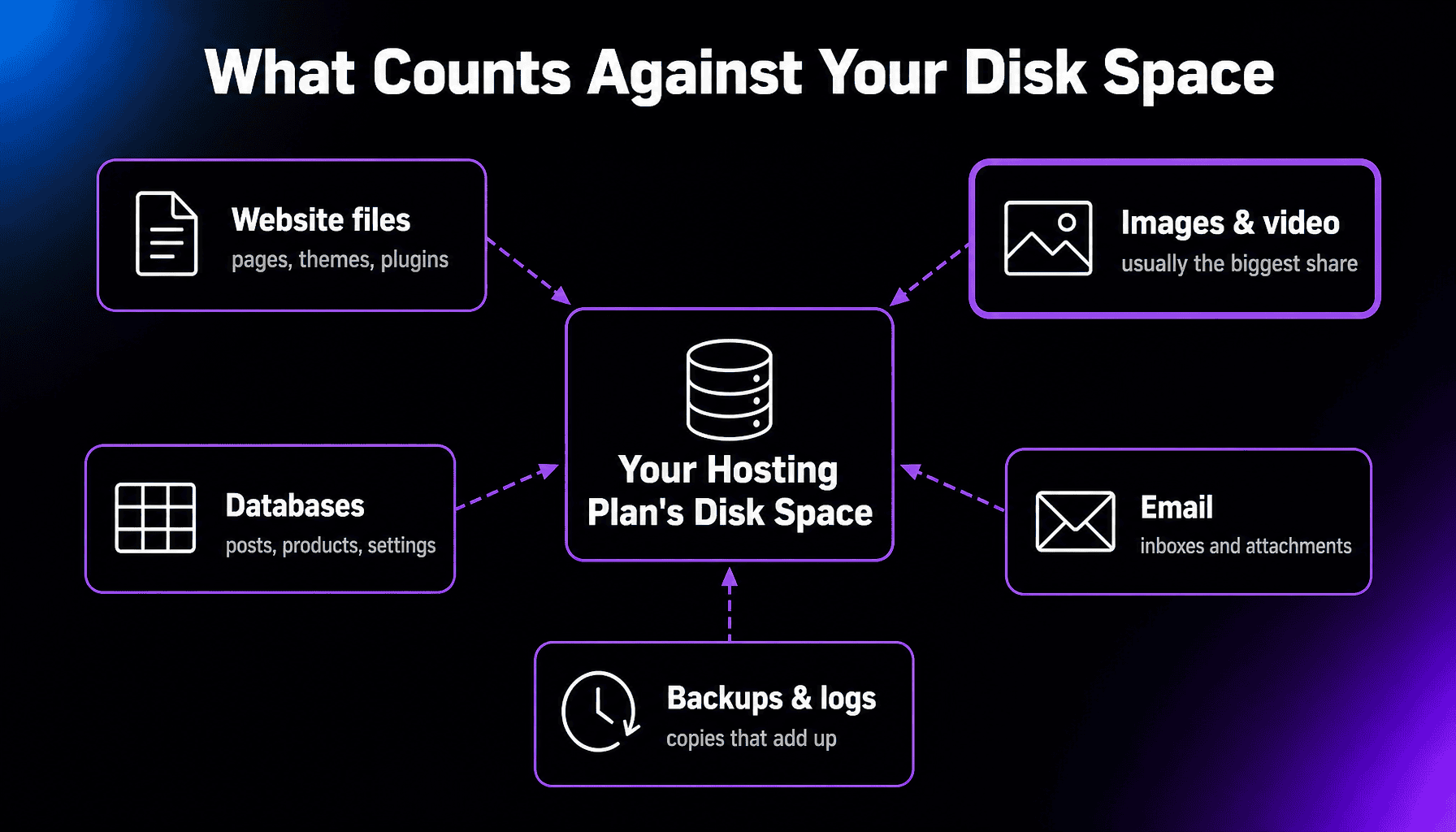
Everything your site stores counts against your disk space. The diagram above breaks down the five main categories. Media is almost always the biggest share. A page of text weighs a few kilobytes. A single photo can run several megabytes, and video dwarfs both. Email counts too if your hosting plan includes mailboxes. An inbox full of attachments can quietly grow for years.
How much disk space does a website need?
Less than most people expect. A typical small-business or portfolio site, WordPress install included, fits comfortably in a few gigabytes. What changes the math is media: large photo libraries, downloadable files, and above all self-hosted video. If you plan to publish lots of video, it’s usually better to upload it to a platform like YouTube and embed it, which uses almost no disk space.
What’s the difference between disk space and bandwidth?
Disk space is what your account stores; bandwidth is what it moves. Your files use the same disk space whether one person visits or a million. Every visit, though, uses bandwidth: pages, images, and video all travel to the visitor. The two scale independently. A rarely-visited photo archive needs lots of disk space but little bandwidth. A viral one-page site is the reverse.
Frequently Asked Questions
Is disk space the same as storage?
In practice, yes. "Storage" is the general term for capacity on any medium, including cloud platforms, while "disk space" traditionally means capacity on a local drive. Hosting plans use the two interchangeably: a plan advertising 50 GB of storage gives you 50 GB of disk space.
Why does a hard drive show less space than advertised?
Manufacturers count in decimal: 1 GB equals one billion bytes. Windows measures the same drive in binary units of 1,024, so a "500 GB" drive displays as roughly 465 GB. No space is missing — the two systems are just counting the same bytes differently.
What happens if my hosting account runs out of disk space?
New data has nowhere to go: file uploads fail, incoming email can bounce, and database writes can error, which may take your site offline. Most hosts warn you as you approach your limit. Free up space by removing unused files, plugins, and old backups, or upgrade your plan.
Does more disk space make a website faster?
No. Capacity doesn't affect speed. The type of storage does: solid-state drives (SSDs) read and write far faster than spinning hard drives, which can speed up database queries and page generation. That's why modern hosts, including DreamHost, run hosting on NVMe SSD storage.