What is WHMCS?
WHMCS stands for Web Host Manager Complete Solution. It’s the billing and automation software that runs many web hosting businesses: it signs customers up, takes payments, creates their hosting accounts automatically, and handles support tickets. Hosting resellers and independent hosts are its main users.
More About WHMCS
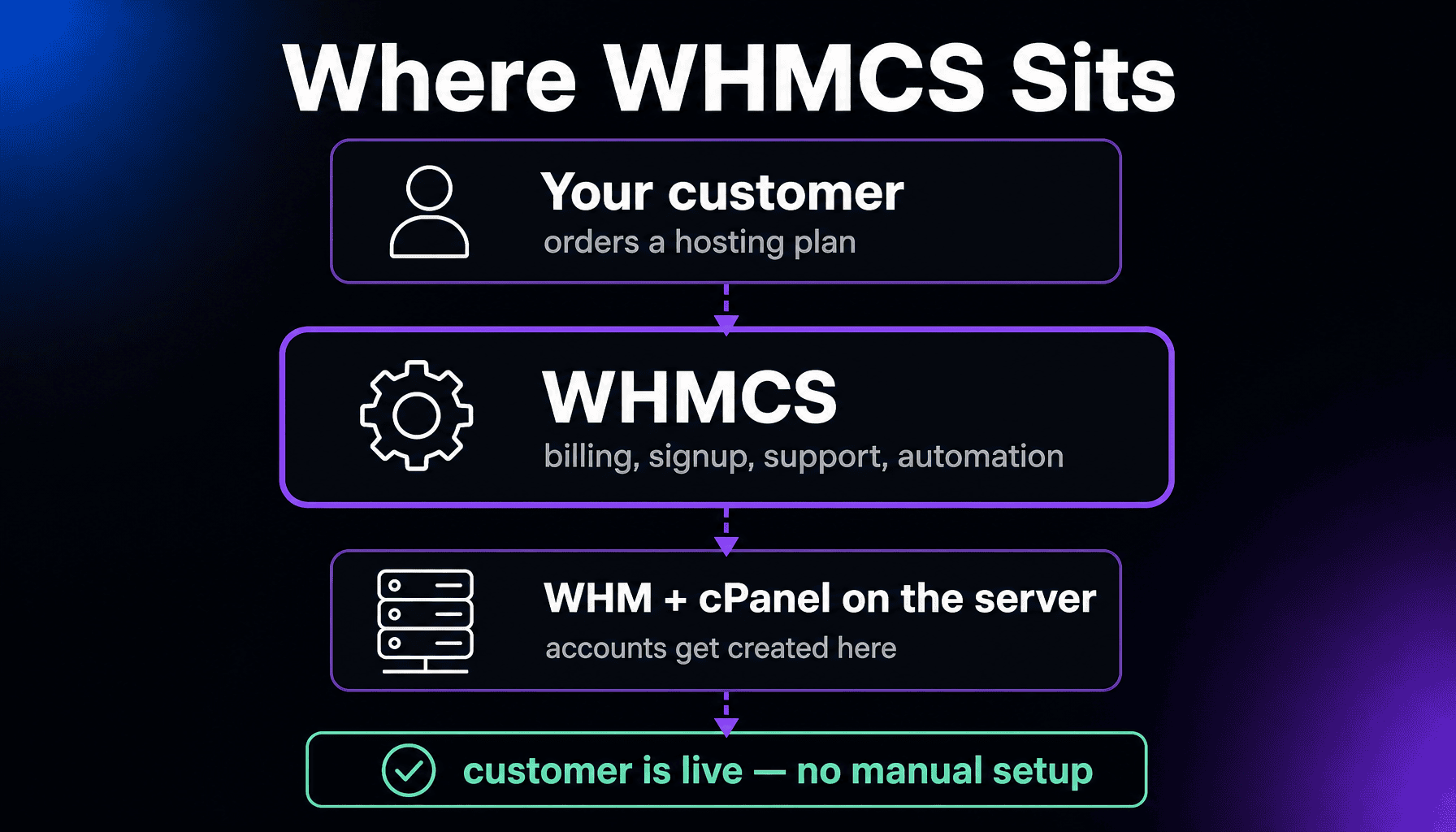
Running a hosting business means invoicing, account setup, suspensions for non-payment, renewals, and support, multiplied by every customer. WHMCS automates that loop. When someone orders a plan, WHMCS takes the payment and provisions the account on the server. It sets up the customer’s control panel access without a human touching anything. It bills on schedule from then on, and suspends or terminates the account if payment stops.
What’s the difference between WHMCS and WHM?
They’re separate products with confusingly similar names. WHM (Web Host Manager) is the server administration layer: it creates and manages the cPanel accounts on a server. WHMCS is the business layer on top: billing, orders, and support. The shared “Web Host Manager” wording reflects WHMCS’s roots: it was built to automate hosting accounts through panels like WHM, and it drives WHM (plus others such as Plesk and DirectAdmin) through their APIs to create accounts. You can run WHM on its own; WHMCS sits above it to handle the business side.
Who uses WHMCS?
Mostly hosting resellers and small hosting companies. A reseller buys server capacity, then uses WHMCS as the storefront. It runs the order forms, automated provisioning, invoices, and client portal, all white-labeled under the reseller’s brand. WHMCS also connects to domain registrars, so the same checkout can register domains. A large ecosystem of modules and its API extend it to other panels, payment gateways, and services.
Does DreamHost use WHMCS?
No. DreamHost built its own control panel and billing system, so accounts here are managed without WHMCS or cPanel. WHMCS matters to you mainly if you’re building your own hosting business on reseller or VPS infrastructure. There, you’d license it as the front office for your customers.
Frequently Asked Questions
Is WHMCS the same as WHM?
No, but they work as a pair. WHMCS takes the order and the payment, then tells WHM to create the account on the server. One runs the business side; the other runs the server.
What does WHMCS stand for?
Web Host Manager Complete Solution, the expansion the software has long been known by. WHMCS today brands itself simply as a web hosting billing and automation platform, and the "Complete Solution" part points to what it adds: the billing, ordering, and client-management pieces a bare server panel leaves out.
Do I need WHMCS to resell hosting?
No. Some reseller programs include their own billing and account tools, and alternatives to WHMCS exist. It becomes worth licensing when you want automated signup-to-suspension billing under your own brand rather than handling customers manually.
Can WHMCS sell domains too?
Yes. Built-in registrar modules for major wholesale providers let customers register or transfer domains at checkout. WHMCS then automates renewals and pushes contact-detail changes back to the registrar where the module supports it.