What is CSS?
CSS stands for Cascading Style Sheets. It’s the style sheet language that controls how web pages look: colors, fonts, spacing, layout, and animation. HTML gives a page its structure and content, and CSS describes its presentation. The “cascade” is the rule system that decides which style wins when several apply.
More About CSS
Nearly every page you’ve ever seen in a browser is styled with CSS. It’s one of the web’s three core technologies, alongside HTML for structure and JavaScript for behavior. The W3C maintains it as an open standard. Browsers read CSS rules (plain text like p { color: navy; }) and apply them to the page’s HTML elements.
What does “cascading” mean in CSS?
“Cascading” is the order a browser follows when several rules target the same element: its built-in defaults, the site’s stylesheet, even the reader’s own settings. The cascade ranks them by origin, then by how specific the selector is, then by source order. The browser applies the rule that wins. That’s why a more specific selector beats a general one, and why a rule you add after a theme‘s stylesheet can override it.
How do you add CSS to a page?
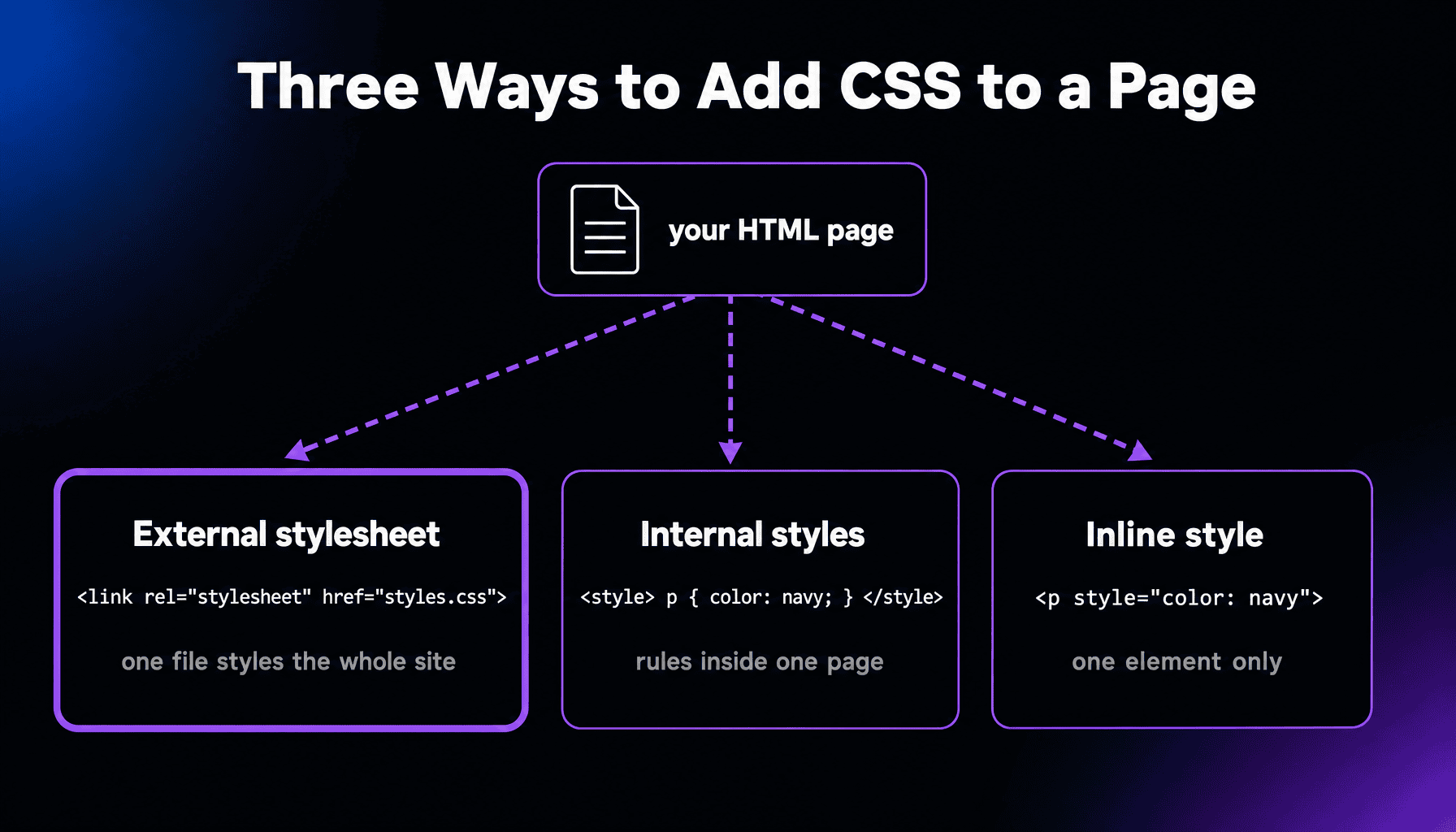
There are three routes, as the diagram above shows. External stylesheets keep all your CSS in a separate .css file that any number of pages can link to. This is the standard approach: one file controls the whole site, and browsers can cache it. Internal styles live inside a <style> block in the page’s HTML and only affect that page. Inline styles sit in a style attribute on a single element; they’re best saved for quick tests and one-off exceptions.
What can CSS do today?
Far more than colors and fonts. Modern CSS handles page layout with flexbox and grid. Media queries adapt a design to any screen size. Transitions and animations run smoothly, no JavaScript needed. Custom properties (variables) let a site define its colors and spacing once and reuse them everywhere. Effects that once required scripts or images — gradients, shadows, rounded corners — are now a line of CSS each.
Frequently Asked Questions
What is the full form of CSS?
CSS stands for Cascading Style Sheets. A "style sheet" is a document of formatting rules, an idea borrowed from print publishing. "Cascading" was the new idea when CSS arrived in 1996: earlier style sheet proposals had no standard way to combine rules from different sources.
Is CSS a programming language?
Not in the traditional sense. CSS is a declarative style sheet language. You describe what an element should look like, and the browser works out how to render it. It has no loops or general logic, though functions like calc() and conditional rules handle some decisions.
What is the difference between HTML and CSS?
HTML defines what's on the page: headings, paragraphs, images, links. CSS defines how it all looks: size, color, spacing, position. They work as a pair, and separating them means you can restyle an entire site without touching its content.
Do I need to write CSS to build a WordPress site?
No. WordPress themes ship complete stylesheets, and the block editor exposes colors, spacing, and typography as settings. Knowing a little CSS still pays off: an Additional CSS field accepts your own rules for tweaks the theme's settings don't cover.