What is Domain Renewal?
Domain renewal is paying your registrar to extend a domain name’s registration before it expires, keeping the name and any website or email attached to it working. Renewals typically add one to ten years to the existing expiration date, and most registrars renew automatically by default.
More About Domain Renewals
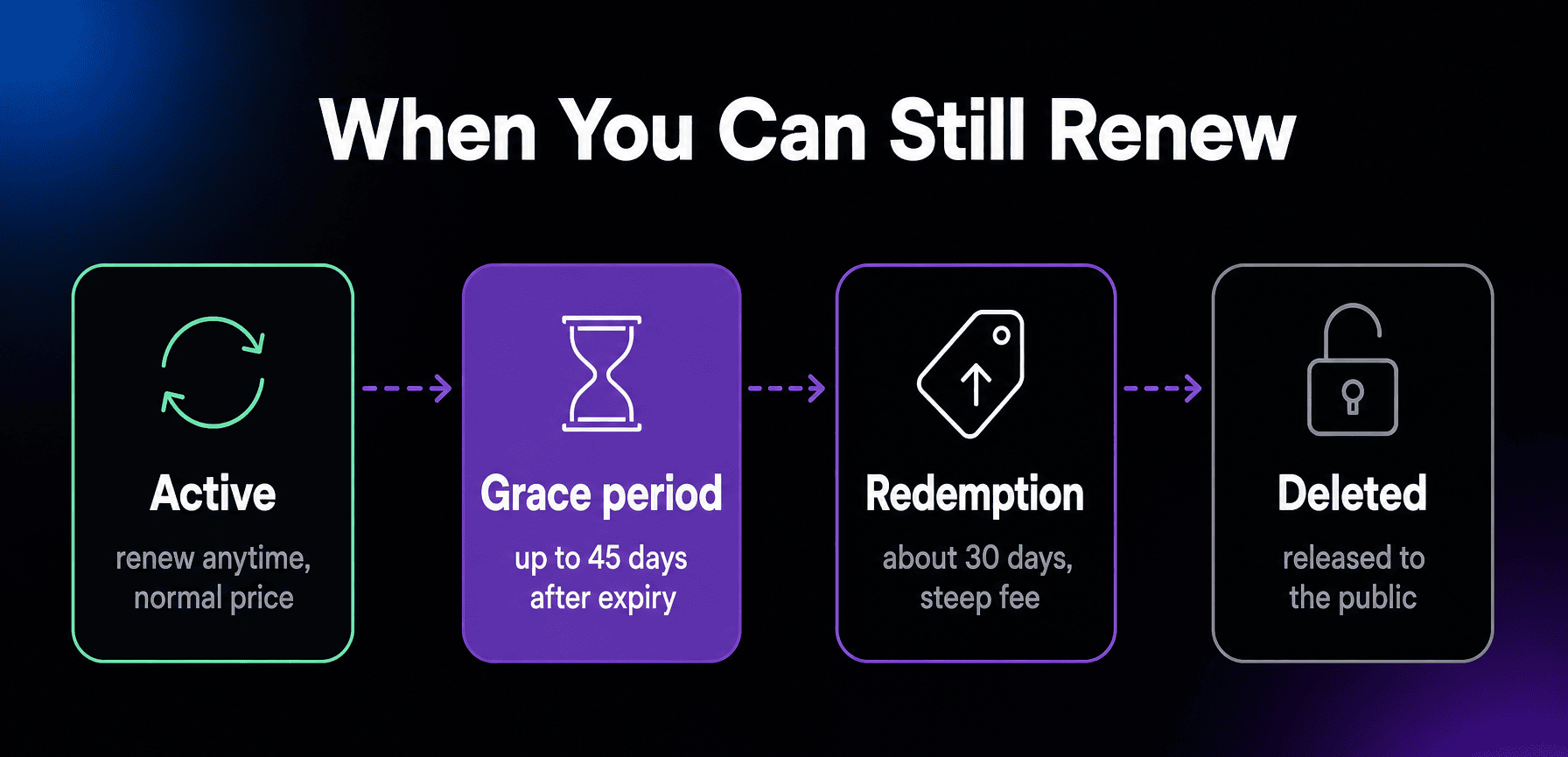
You never own a domain outright; you register it for a term and renew to keep it. As the diagram above shows, renewing is cheap and easy while the registration is active, still possible during a short grace period after expiry, expensive during redemption, and impossible once the name finally drops and goes back on the open market.
How does domain renewal work?
You pay your registrar and the new time is added to your current expiration date, so renewing early doesn’t cost you any of the time you’ve already paid for. You can renew whenever you like, not just near the deadline, though most extensions cap the total registration at ten years out.
What happens if you don’t renew?
The domain expires and the website and email on it usually stop working within days, but the name isn’t gone yet. Most registrars give you a renewal grace period, often around 30 days and up to 45, to renew at the normal price. Some add a late fee, and some auction expiring names during this stretch. After that comes a roughly 30-day redemption period with a much steeper recovery fee; at DreamHost, redeeming a .com costs $150 on top of the renewal. Only after redemption and a final five-day pending-delete stage is the name deleted and released. Our deleted domain guide walks through the full timeline.
Should you use auto-renew?
Yes, for any domain you’d mind losing. Auto-renew charges your saved payment method before expiry, which turns renewal from a deadline into a non-event. It can still fail when a card expires or a payment bounces, so keep your billing details current; ICANN also requires registrars to send renewal reminders roughly a month and a week before expiry, which only helps if the address on your account is one you read.
Frequently Asked Questions
Can I renew a domain after it expires?
Usually yes, briefly. Most registrars let you renew during a grace period after expiry, usually at the normal price, but the window and cost depend on your registrar and extension, and some country-code domains skip the recovery stages entirely. Treat the post-expiry window as a safety net, not a plan.
Does transferring a domain to another registrar renew it?
Usually. Transferring a gTLD to a new registrar adds one year to your existing expiration date; the transfer fee is essentially that year's renewal, which is why transfers make sense near renewal time. The ten-year cap still applies, and many ccTLDs, like .uk, add no year at all.
Why is my renewal price higher than what I paid at first?
First-year prices are often promotional discounts, and renewals bill at the regular rate. Renewal prices can also rise over time because registries raise their wholesale fees, which registrars pass along. Premium domains often carry premium renewal pricing too, so check the renewal rate before you register.
Does renewing a domain require updating my contact information?
No. Renewal is just a payment that extends the registration. Keeping your contact details accurate is a separate ICANN requirement that applies all the time, so update it whenever it changes, not just at renewal.