What is Google's BERT Update?
Google’s BERT update is the October 2019 rollout of the BERT language model into Google Search. BERT (Bidirectional Encoder Representations from Transformers) helps Google understand what a query means by reading its words in relation to each other, in both directions. At launch it affected about one in ten English-language searches in the US.
More About Google's BERT Update
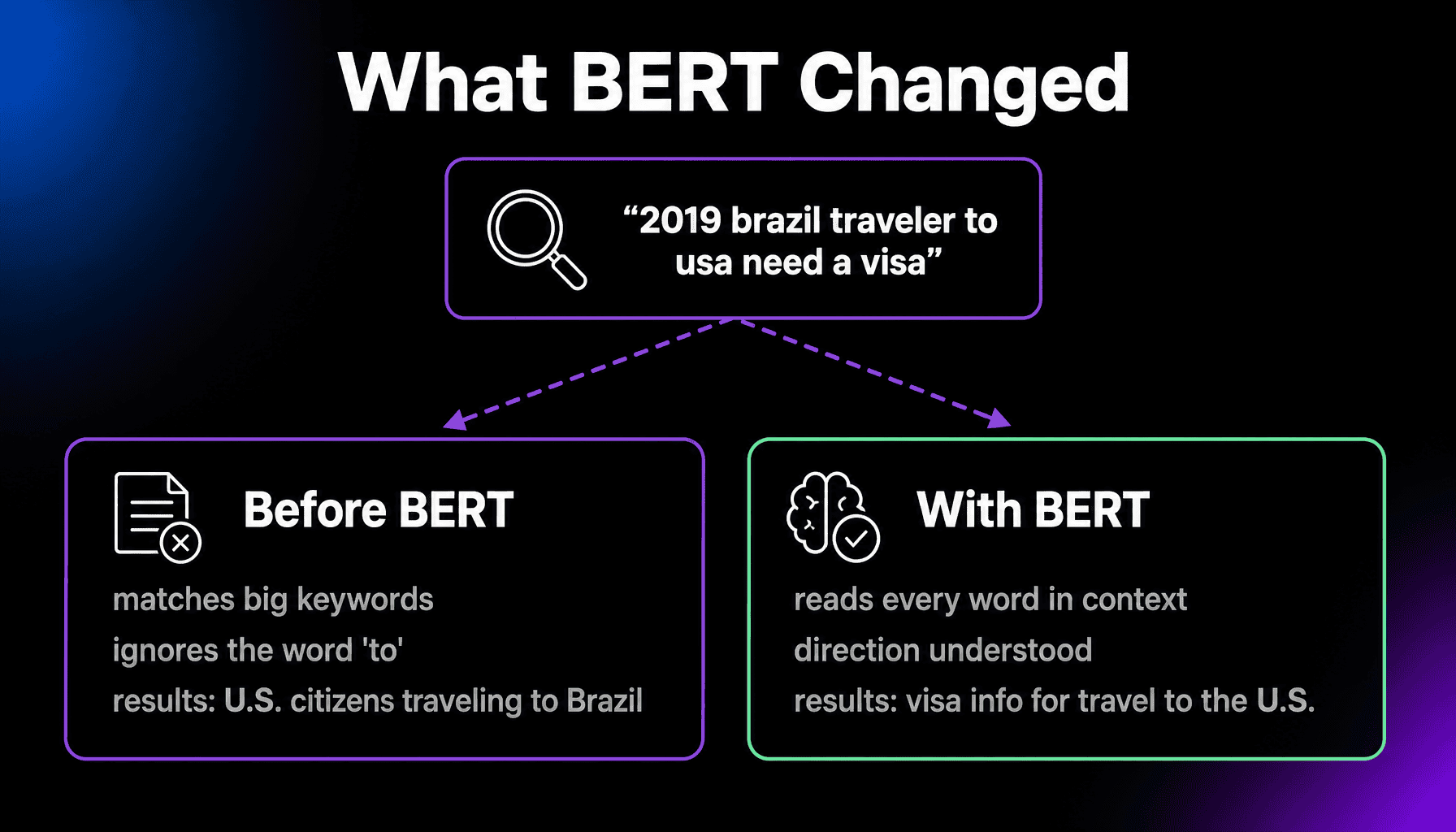
Google called BERT the biggest leap forward for Search in five years. The reason was small words. Before BERT, Google largely matched the big keywords in a query and missed how connectors like “to,” “for,” and “no” changed the meaning. Once BERT could weigh those connectors against the rest of the sentence, the direction and intent of a query finally counted.
How did BERT change search results?
BERT’s clearest change was reading a query’s direction. Google’s launch example was “2019 brazil traveler to usa need a visa” — as the diagram above shows, the small word “to” decides who is traveling where, and only BERT read it correctly. Google also used a BERT model to improve featured snippets.
Can you optimize for BERT?
No, and Google said so directly: there’s nothing to optimize for. BERT scores no pages; it just helps Google read its users better. The upside is simple. Write naturally and answer real questions, and you no longer have to speak in keyword shorthand. Any page that lost traffic had been matching searches it never really answered.
Is BERT still used today?
Yes. Google still lists BERT among the active systems in its ranking systems guide, and it works alongside the newer AI systems that came after it. By 2020, Google said BERT was used in almost every English-language query, far beyond the original one in ten. Unlike core updates, which periodically reassess content quality, BERT is standing infrastructure: it changed how Search reads language, and that change stuck.
Frequently Asked Questions
When was the Google BERT update?
Google announced it on October 25, 2019, with the rollout already underway that week for English queries in the US. On December 9, 2019, Google confirmed BERT had expanded to over 70 languages worldwide.
What does BERT stand for?
Bidirectional Encoder Representations from Transformers. It's a neural network technique for language understanding that Google open-sourced in 2018, a year before applying it to Search. "Bidirectional" is the key part: it reads context from both directions of a sentence at once.
Did the BERT update penalize websites?
No. BERT issues no penalties and has no target to hit. A spam update can demote a site for bad practices; BERT simply changed how Google reads the words in a search. There is nothing it can flag your pages for.
What's the difference between BERT and RankBrain?
They're separate systems, and Google's ranking systems guide lists both as active. RankBrain, from 2015, helps Google understand how words relate to concepts, while BERT parses the language of a query itself. They can both apply to the same search.